An open-sourceautonomous software factory.
A local-first control center for coding agents. They run in parallel, and they ship without losing context.
brew install --cask missingstudio/tap/evaThe console
Eva drives its own harness today. The adapters that put the harnesses you already pay for behind the same contract.

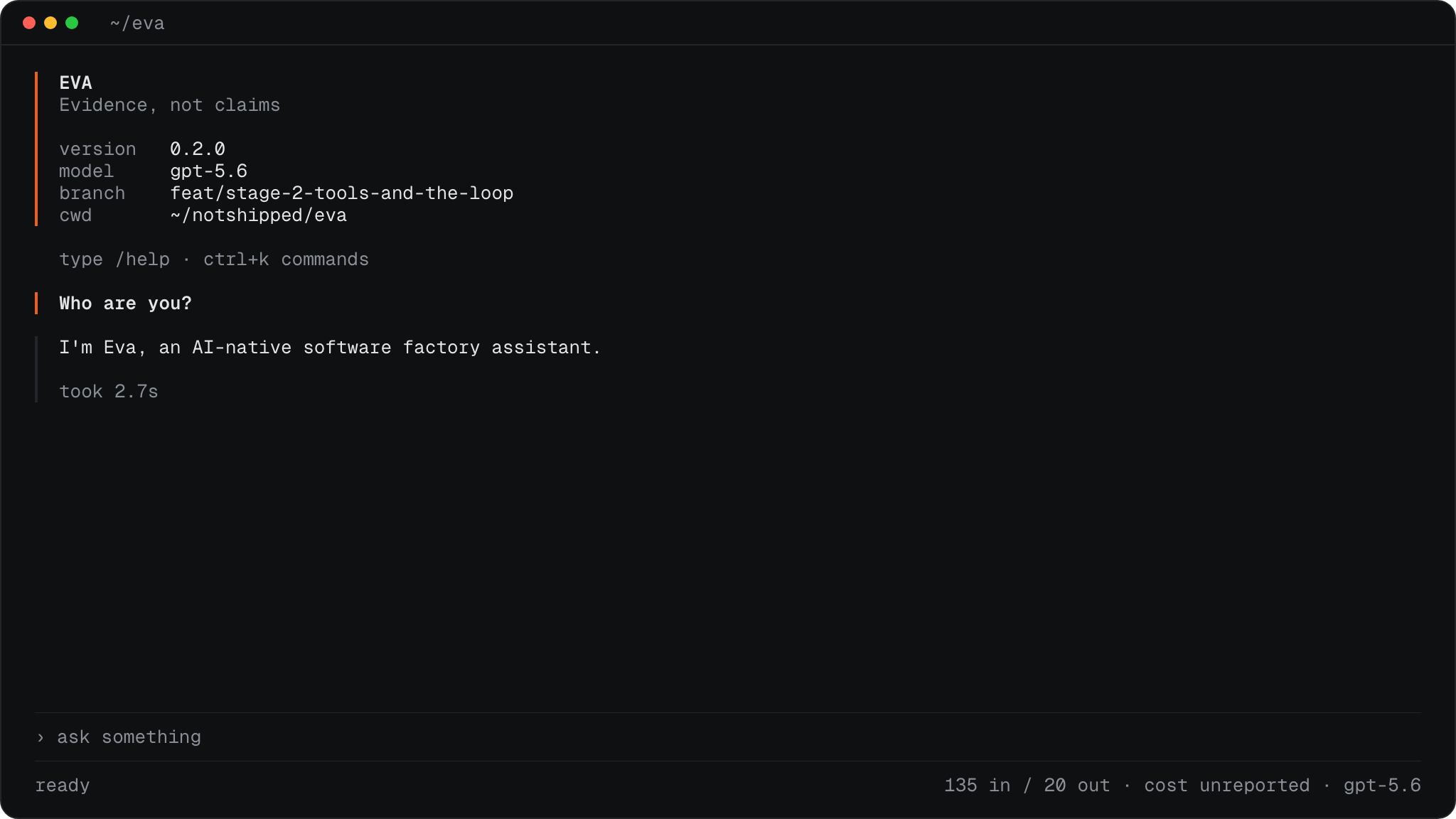
What Eva does today
Shipping, and provable.
Every capability is a plugin
A small kernel loads plugins. The model, the surface, the trace, the themes — each one is a plugin, and any of them can be replaced or switched off.
Read →A session survives kill -9
Everything Eva shows is folded from a durable trace on disk. There is no in-memory state a crash could lose, because there is none that matters.
Read →You can see what a run cost
Eva records what the provider said a request cost, in integer ticks. It marks an estimate as an estimate, and never multiplies tokens by a rate and calls it a cost.
Read →A repository earns its trust
Eva reads a project's .eva directory only after you run eva trust there. The grant is a verb you type, not a file a repository can ship.
Read →Local-first, and open
Your key never reaches a settings file, a log, or the session record.
Eva reads a repository’s configuration only after you grant it. Everything runs on your machine.
Eva is MIT licensed and the whole tree is public. Missing studio is the company behind it, and its first product is Eva as a managed service — the same tree, operated for you. Self-hosting is not a downgrade path.
Questions
What is an open-source autonomous software factory?
A system that runs coding work from a spec a machine can check to evidence that it was done, with one contract over every harness, one trace of what they did, one verifier that decides whether the work passed, and one bill that prices it. Eva is an open-source implementation of that category.
What is a coding agent harness?
A harness is the thing that takes a prompt and drives it to a stopping point. Claude Code, Codex, and OpenCode are harnesses, and so is Eva's own loop. Eva drives harnesses rather than competing to be a better one.
How do I verify a coding agent's work instead of trusting its claim?
You have something other than the agent check it. Eva records the agent's claim as a claim, in the trace, and never as evidence. The verifier that checks acceptance criteria itself — and can score a diff produced by any harness — is stage 5 on the roadmap.
Can Eva run coding agents in parallel, or overnight?
Not yet. Racing one spec across harnesses in separate git worktrees is stage 9c, and unattended overnight work needs the queue and daemon at stage 9a. Durable sessions, which both depend on, ship today.
What happens if Eva crashes in the middle of a task?
Nothing is lost. Everything Eva shows is folded from a durable trace on disk, so a session survives kill -9. There is no in-memory state a crash could lose, because there is none that matters.
Is Eva free and open source?
Yes. Eva is MIT licensed and the whole tree is public. There is no paid tier that unlocks capability, and self-hosting is not a downgrade path.
Do I need new API keys or another subscription?
One Anthropic API key, set in your environment. Eva drives the harnesses you already pay for rather than reselling access to them.
Where do my code and my key go?
Nowhere. Eva runs on your machine. Your key is read from the environment and never reaches a settings file, a log, or the session record.
How is this different from running Claude Code directly?
Claude Code is a harness. Eva drives harnesses behind one contract, records everything in one trace, and attributes cost per task. Eva's own harness has no privileged position.
What actually works today?
A terminal client on a plugin kernel: one provider, one interactive surface, durable sessions, and cost accounting. The multi-harness contract and the verifier are on the roadmap.
Run it now.
brew install --cask missingstudio/tap/eva